


Purified Water Equipment for Production of Traditional Chinese Medicine Decoction Pieces
Contact Info
- Add:No. 318 Zhenxing Road, Che Dun Town, Dan Lai Shang Chuang Yuan, Building D, Zip:
- Contact: 胡先生
- Tel:18721141386
- Email:411243788@qq.com
Other Products


Purified Water Equipment for Traditional Chinese Medicine Decoction Piece Production: Core Technology Analysis and Application Guide
Chapter 1: The Importance of Purified Water in Traditional Chinese Medicine Decoction Piece Production
As a crucial component of traditional Chinese medicine, the quality of decoction pieces directly impacts drug safety and efficacy. The water quality required in the production process, especially the quality of purified water, is a core factor influencing key steps such as processing, extraction, and drying of decoction pieces.
1.1 Purified Water Standards and Regulatory Requirements
According to the Chinese Pharmacopoeia, the purity of water used in the production of traditional Chinese medicine decoction pieces must meet purified water standards, with a conductivity of ≤5.1 μS/cm (25°C). Microbiological limits, heavy metal content, and other indicators must also strictly comply with regulations. The use of ordinary tap water or substandard water sources may lead to issues such as loss of active ingredients, microbial contamination, and even affect the compliance of the drug.
1.2 Impact of Water Quality on Production Processes
During the processing of decoction pieces, purified water is directly involved in steps such as cleaning, soaking, and boiling. If the water contains impurities or microorganisms, it may introduce heavy metal residues or bacterial growth, leading to the destruction of active ingredients or microbial超标 in the product. For example, when cleaning rhizome herbs like Astragalus and Codonopsis, using water with high chlorine content may cause oxidation and discoloration of the herbs. In the steaming process of prepared Rehmannia, calcium and magnesium ions in hard water may affect boiling efficiency.
1.3 Industry Challenges and Solutions
Currently, some small and medium-sized pharmaceutical companies still use traditional distilled water equipment or simple filtration devices, which suffer from high energy consumption, unstable water production, and high maintenance costs. Modern purified water equipment, integrating technologies such as reverse osmosis (RO) and electrodeionization (EDI), enables continuous and efficient water production, meeting GMP certification requirements and becoming a key choice for industry upgrades.
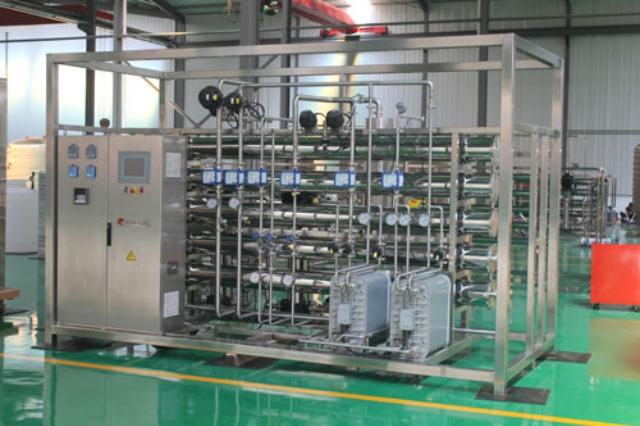
Chapter 2: Core Technologies and Working Principles of Purified Water Equipment
Purified water equipment for traditional Chinese medicine decoction piece production typically adopts a multi-stage process combination of "pretreatment + reverse osmosis + polishing treatment" to ensure stable and达标 water quality. The following is an analysis of the key technology modules of the equipment:
2.1 Pretreatment System: Ensuring Long-Term Operation of the Equipment
Pretreatment is the first step in purified water preparation, primarily addressing issues such as suspended solids, colloids, and residual chlorine in the raw water:
- Multi-Media Filter: Uses multiple filter materials such as quartz sand and activated carbon to remove large particles like sediment and rust from the water.
- Softener: Utilizes ion exchange resin to adsorb calcium and magnesium ions, reducing water hardness and preventing scaling on the subsequent reverse osmosis membrane.
- Precision Filter: Equipped with a 5μm filter cartridge to intercept tiny particles and protect the reverse osmosis membrane from mechanical damage.
2.2 RO Reverse Osmosis Technology: The Core Step for Efficient Desalination
The reverse osmosis membrane is the core component of purified water equipment, with a pore size of only 0.0001 micrometers, capable of removing over 97% of dissolved salts, organic matter, and microorganisms from water.
- High-Pressure Pump Drive: Uses a high-pressure pump to pressurize the raw water to 6-8 bar, forcing water molecules through the reverse osmosis membrane while impurities are retained and discharged from the concentrate side.
- Intelligent Control: Equipped with an online conductivity monitor and automatic flushing function to ensure real-time达标 water quality and extend membrane life.
2.3 EDI Electrodeionization Technology: Achieving Chemical-Free Polishing Treatment
The EDI module combines ion exchange resin and a direct current electric field to continuously remove residual ions without the need for acid and alkali regeneration:
- Continuous Water Production: Uses an electric field to directionally migrate cations and anions in the water to the concentrate chamber, achieving a product water resistivity of 15 MΩ·cm or higher.
- Environmental Protection and Energy Savings: Compared to traditional mixed-bed processes, EDI technology reduces chemical usage by 90% and lowers wastewater discharge.
2.4 Storage and Distribution System: Preventing Secondary Pollution
Purified water storage tanks are made of 316L stainless steel with electropolished inner walls, equipped with nitrogen sealing and ultraviolet sterilization devices to prevent microbial growth. The circulation pipeline design follows the principle of "turbulent flow + dead leg control" to ensure that water quality at usage points meets pharmacopoeia requirements.
Chapter 3: How to Choose Purified Water Equipment Suitable for Traditional Chinese Medicine Decoction Piece Production
Equipment selection must comprehensively consider factors such as production capacity requirements, water quality standards, and operating costs. The following is a key selection guide:
3.1 Determining Water Production Scale and Water Quality Grade
- Production Capacity Calculation: Determine the equipment's water production capacity based on the company's daily decoction piece output and process water consumption (e.g., cleaning, boiling, extraction). For example, a company with an annual output of 500 tons of decoction pieces typically requires a purified water system with a capacity of 1-2 tons/hour.
- Water Quality Grading: For producing decoction pieces for direct oral use (e.g., Panax notoginseng powder), a "double-stage RO + EDI" process is recommended; for普通 decoction pieces, a single-stage RO system may suffice.
3.2 Equipment Materials and Certification Requirements
- Material Standards: Pipes and storage tanks in contact with water must be made of 316L stainless steel and undergo surface treatment meeting GMP requirements (e.g., Ra ≤ 0.6 μm).
- Compliance Certification: The equipment must provide material certificates, pressure vessel certificates, and support 3Q validation (IQ installation qualification, OQ operational qualification, PQ performance qualification).
3.3 Energy Savings and Operational Cost Comparison
- Energy Consumption Analysis: Traditional distilled water machines consume 80-100 kWh to produce 1 ton of purified water, while the RO + EDI combination reduces energy consumption to 15-20 kWh/ton.
- Maintenance Convenience: Choose modularly designed equipment that supports quick replacement of filter cartridges and membrane elements to reduce downtime.
3.4 Supplier Service Capability Assessment
Prioritize suppliers with experience in the pharmaceutical industry, offering one-stop services from design and installation to validation, and committing to 24-hour technical support. For example, when a branded equipment supplier customized a purified water system for a well-known pharmaceutical company, they added a secondary softening device to address the local water's high hardness, ensuring long-term stable system operation.
Chapter 4: Typical Application Cases and Effect Analysis
4.1 Case 1: Upgrade Project for a Provincial Traditional Chinese Medicine Decoction Piece Enterprise
- Original Challenges: The existing distilled water machine had slow production speed (0.5 tons/hour), and microbial超标 was common in summer.
- Solution: Installed a 1.5 tons/hour RO + EDI system paired with a pasteurization circulation system.
- Results: Annual electricity savings of 120,000 RMB, with a 100% pass rate in microbial指标抽检 for purified water over three consecutive years.
4.2 Case 2: Water Quality Optimization for an Oral Decoction Piece Production Line
When producing American ginseng lozenges, a company found that chloride ions in the raw water caused a涩 taste in the product. After upgrading to purified water equipment, chloride ion content dropped from 1.2 mg/L to 0.05 mg/L, and customer complaints decreased by 80%.
4.3 Industry Data Reference
According to the "2023 Pharmaceutical Water System White Paper," companies using intelligent purified water equipment saw an average 15% increase in the first-pass inspection qualification rate for decoction pieces, with an equipment investment payback period of approximately 2-3 years.
Chapter 5: Equipment Maintenance and Common Issue Solutions
5.1 Daily Maintenance Key Points
- Pretreatment System: Replace activated carbon and softening resin every 3 months to prevent microbial growth.
- Reverse Osmosis Membrane: Perform chemical cleaning monthly (citric acid + EDTA) to restore membrane flux.
- EDI Module: Regularly check electrode voltage to ensure stable current between 1-3A.
5.2 Common故障处理指南
- Increased Product Water Conductivity: May be due to RO membrane damage or seal aging; requires停机排查 and component replacement.
- Decreased Water Production: Check if the pretreatment filter is clogged or if the high-pressure pump pressure is insufficient.
5.3 Suggestions for Extending Equipment Lifespan
- Raw Water Quality Control: Inlet water turbidity should be <1 NTU; avoid directly introducing high-hardness or high-COD water into the system.
- Data-Driven Operation and Maintenance: Integrate with a SCADA system for real-time monitoring of water quality parameters and predictive replacement of consumables.
Conclusion
Purified water equipment for traditional Chinese medicine decoction piece production is not only a necessary configuration to meet regulatory requirements but also a core asset for enterprises to enhance product quality and reduce production costs. By selecting suitable process solutions and focusing on full lifecycle management of the equipment, pharmaceutical companies can effectively mitigate water quality risks and provide safe and reliable traditional Chinese medicine products to the market. For more information on equipment technical parameters or customized solutions, contact a professional team for one-on-one consulting services.
| Industry Category | Others |
|---|---|
| Product Category | |
| Brand: | 奥力原 |
| Spec: | ALY-CHS-1T |
| Stock: | 99 |
| Manufacturer: | 上海奥力原环境科技有限公司 |
| Origin: | 113117 |


